

This article builds on the harness work we described in our earlier post on cutting agentic AI costs with Vercel’s Eve:

Our Form-Filling Assistant has been through another round of testing aimed at reducing costs. This time, we added in Jev, a model from TypeSafe AI, to see how it changes things. We wanted to know two things: (1) can it still fill out benefit applications reliably, and (2) does it cost less to run?
Short answer: yes to both. Here’s one example from a run on the In-Home Supportive Services (IHSS) website on Sep 23. The same application cost $5.39 with neither Eve nor Jev, $2.40 with Eve, and $1.23 with both. That’s about 77% cheaper than the baseline and 49% cheaper than Eve alone. It was also faster, finishing in about 1 minute, compared with 3 minutes with Eve and over 5 minutes with neither. It ran with no errors.
One of Jev’s main jobs in that run was a gap analysis. It takes in the form data as JSON and works out which fields the form still needs that aren’t in the data. Before we get into how that works, let’s look into what Jev is and why we decided to use it.
Jev: structured answers for machines, not text for humans
Jev is a model from TypeSafe AI. TypeSafe calls it a “System One” model: one built to make fast, structured decisions inside software rather than to write text for people to read.
Most models are trained to chat. That makes them good at following instructions, but it also means they produce extra wording, like visible reasoning and filler, that costs tokens and that your code then has to parse. Jev doesn’t generate text. You send it your data and a set of typed questions, and it returns typed answers your code can use directly. The question types are choose-from-a-list, score-on-a-rubric, and true/false. Answers come back with probabilities, and some also include a confidence estimate.
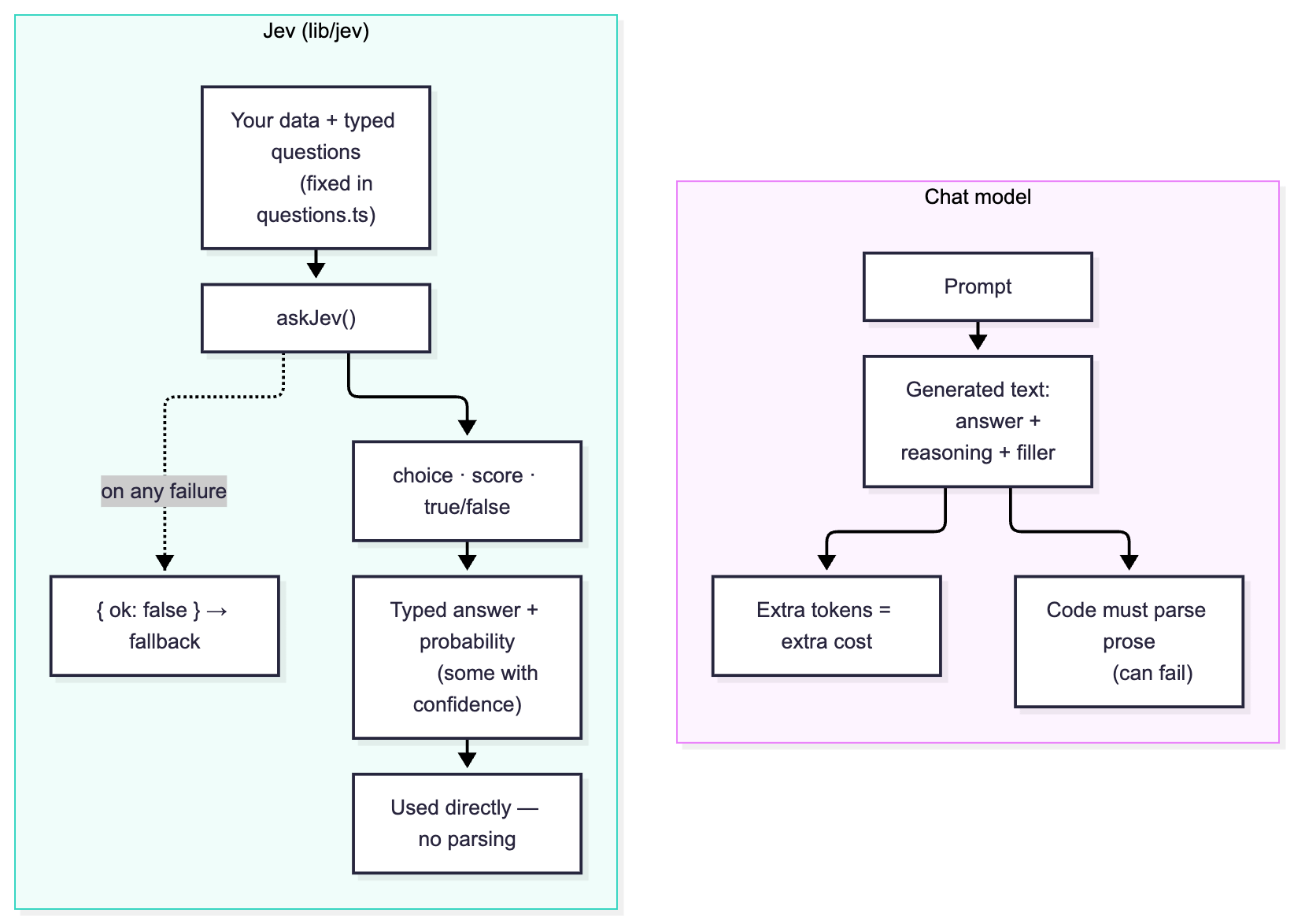
We use Jev where our code needs a bit of semantic judgment, such as deciding whether a form field is missing. We don’t use it to drive the agent. Our questions are written in code and versioned, and the agent never writes them, so we can test them against fixed cases. This matches TypeSafe’s own advice: ask small, specific questions and combine the answers in code.
How we use Jev
Our Form-Filling Assistant takes in JSON data and uses it to fill out forms on government sites. Jev helps by analyzing the form and the data together. It identifies which data belongs in which field and what’s missing, and it does this faster and at lower cost than an LLM. As TypeSafe notes:
Jev returns typed decisions with calibrated probabilities, so your software can account for uncertainty. Set the thresholds for when it acts autonomously and when it asks for review. Combine those decisions in code to build larger workflows, with control over how the intelligence is used.
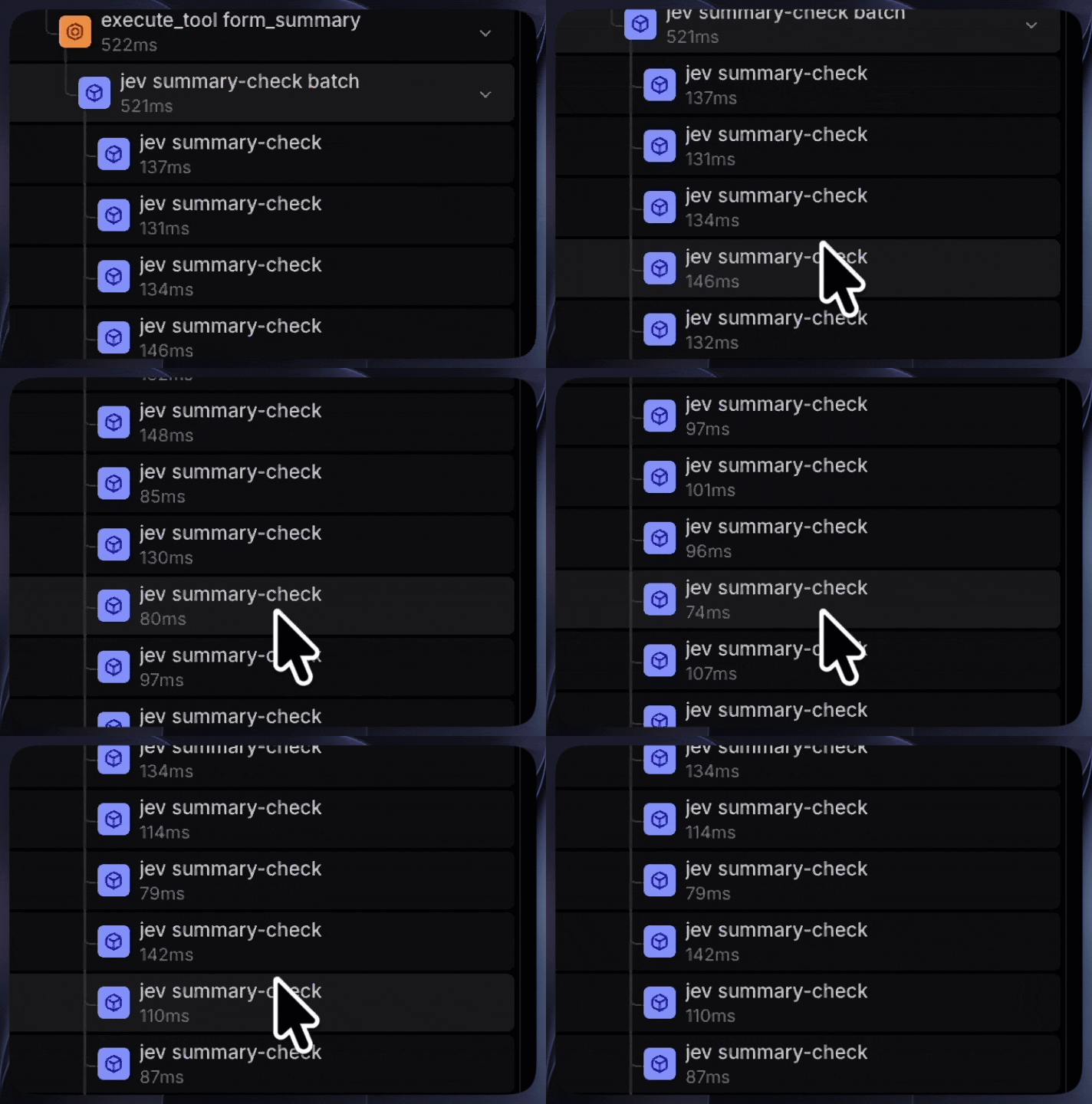
In the original browser-in-browser application, Jev takes on two main roles: the gap analysis and the summary. The gap analysis runs after Jev views the JSON data and the form, and determines what is or isn’t missing. The summary is run after the form is filled out.
Results from Jev
Jev improved our application in three ways:
Speed: Forms were filled out faster.
Consistency: The gap analysis was more consistent about missing fields.
Cost: It cost less.
1. Faster form filling
On the WIC (Women, Infants, and Children) form, Jev produced the gap analysis in 15 seconds. The application then took another 19 seconds to fill out the form and produce the summary, for a total of 34 seconds.

IHSS is our older form, and its hidden items and fields gave us a hard time. Jev handled the analysis without trouble. It averaged 15 seconds for the gap analysis, and the form was filled out in another 45 seconds. Before Eve and Jev, this application averaged about 6 minutes.
2. A more consistent gap analysis
Before Jev, the gap analysis often changed from run to run. With the same JSON data, the model would reach a different answer each time about what was missing. It varied in what it assumed versus what it actually had, and even in how it read the question. With Jev, the results rarely changed. Using the same model and the same data, Jev gave back the same list of missing information.
3. Lower cost
Jev brought costs down again on top of Eve. To connect this to my earlier post on Eve, I’m comparing against the numbers from those experiments.
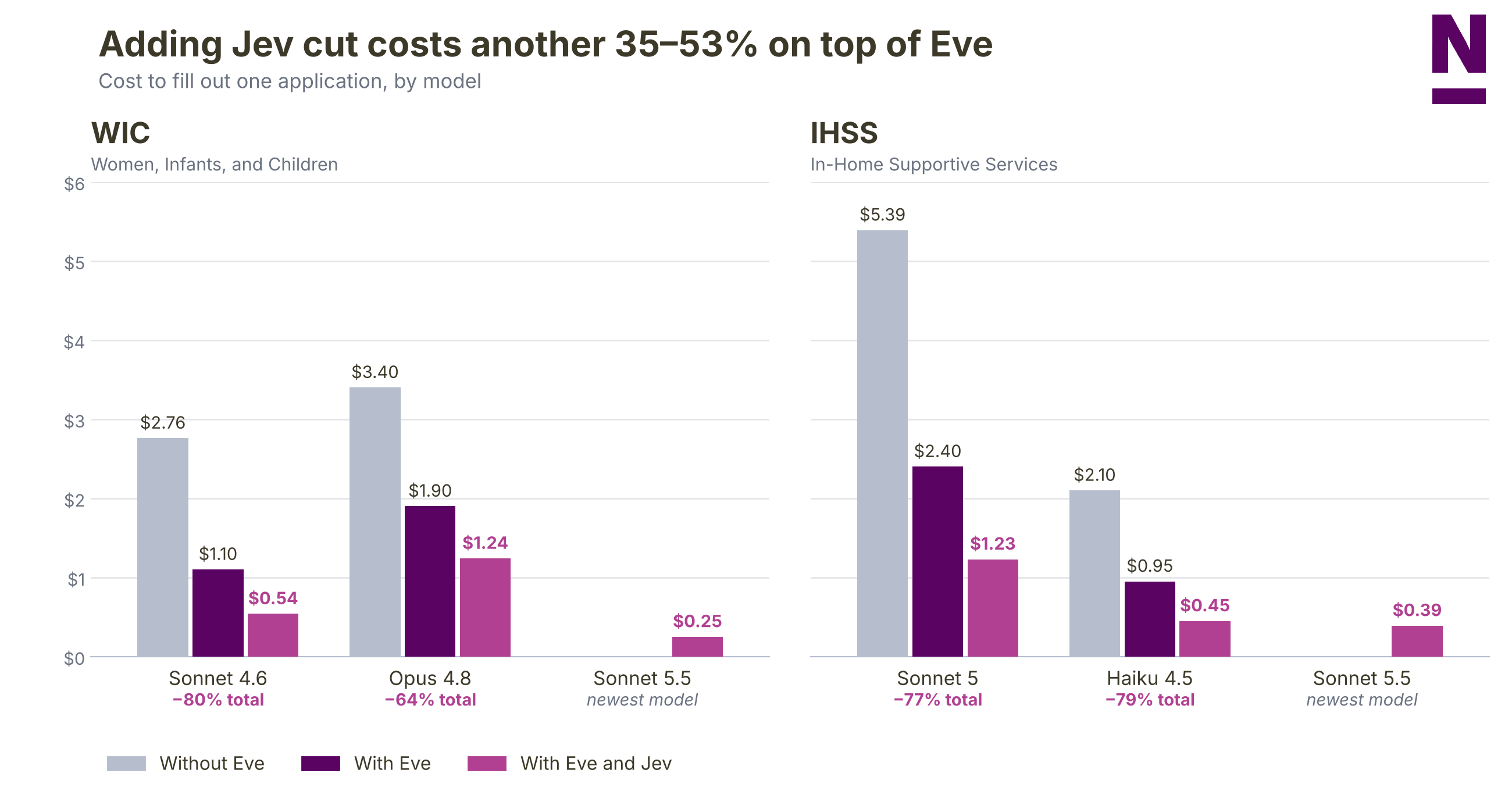
WIC (Women, Infants, and Children) — the smallest application we support:
Sonnet 4.6: $2.76 without Eve → $1.10 with Eve → $0.54 with Eve and Jev. Jev cut another 51% from the Eve cost, and the total decrease is 80%.Opus 4.8: $3.40 without Eve → $1.90 with Eve → $1.24 with Eve and Jev. Jev cut another 35%, and the total decrease is 64%.
IHSS (In-Home Supportive Services) — a one-page application, but an older one
Sonnet 5: $5.39 without Eve → $2.40 with Eve → $1.23 with Eve and Jev. Jev cut another 49%, and the total decrease is 77%.Haiku 4.5: $2.10 without Eve → $0.95 with Eve → $0.45 with Eve and Jev. Jev cut another 53%, and the total decrease is 79%.
We also tested newer models. Sonnet 5.5 gave us the best reliability and cost reduction: WIC cost only $0.25 and IHSS only $0.39. Compared with Sonnet 4.6 and Sonnet 5 with Eve and Jev, that’s about 54% and 68% lower.
What’s next for the Form-Filling Assistant
We’re testing every day to make the application more reliable and more useful to caseworkers. With a reliable harness, Jev, and lower costs in place, our next question is whether the same setup can work behind a different interface. We’re now exploring a Chrome extension.
Good work. The per-form cost drop is the part that matters. A cheaper model that stays reliable changes what a team can afford to run. That is the kind of detail that gets lost in headline token prices.
Kaylyn, excellent work and very good article. I restacked - you explain the thing professionally, yet in such a way that a reader who does not know the topic (myself) is getting properly introduced to it and then, step by step, understand what you've done. Excellent writing work. Regarding the topic itself and your solution: I found your story because of my own work with Jev lately. I think yours and mine solution falls into what is becoming the norm: the "cascading" approach, where cheap decision models make preliminary yes/no decisions, leaving only the curated, final tasks to the expensive LLM. Congratulations; my story is below if that is of interest.
https://www.ondata.blog/p/i-tried-to-replace-claude-with-jev-174